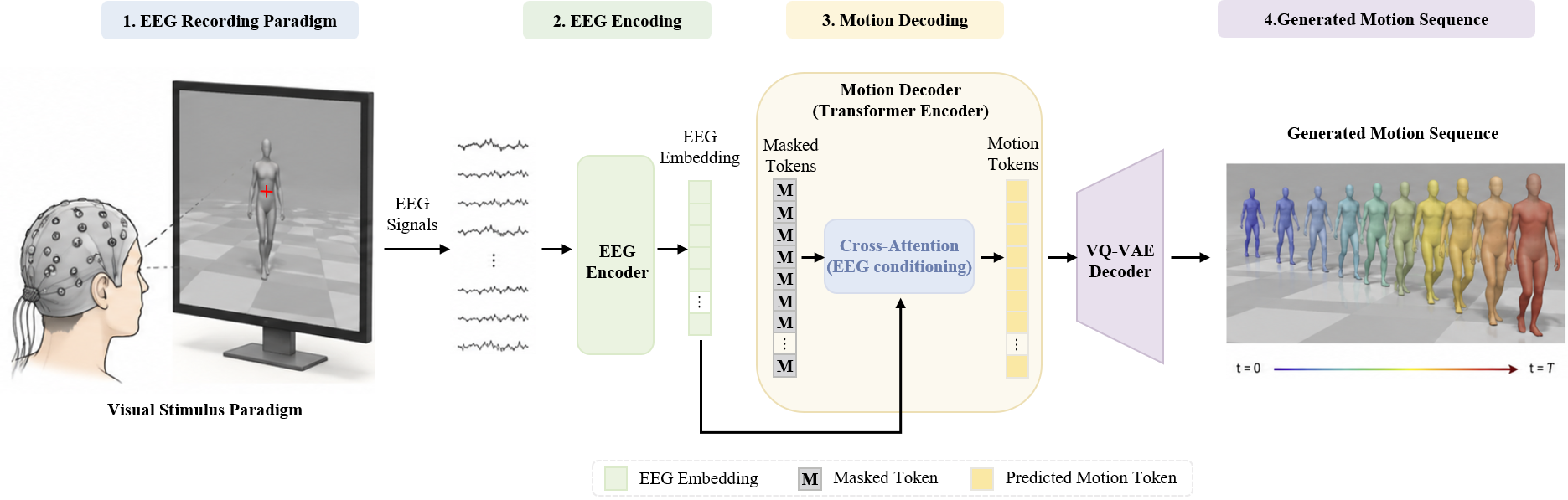
Human motion is governed by a hierarchical motor system where the brain provides high-level intentions and lower-level structures coordinate detailed dynamics. Existing brain-computer interfaces (BCIs) typically oversimplify this into constrained classification or low-dimensional control, failing to capture the richness of natural movement. Bridging this gap to achieve diverse, full-body motion synthesis remains challenging due to the substantial cross-modal divergence between sparse neural signals and high-dimensional kinematics, as well as the lack of large-scale paired EEG-motion datasets. To address this, we introduce EEG2MOTION, a dataset suite with three subsets: AO-16, comprising motion-observation recordings from 7 subjects across 16 distinct actions and 20,000 samples, AO-Open, comprising open-vocabulary motion-observation recordings from 9 subjects with 28,000 paired EEG-motion-text samples across thousands of motions, and MI-Open, comprising open-vocabulary motor-imagery recordings from 7 subjects and 5,250 paired samples. This is the first dataset suite designed specifically for open-vocabulary motor BCIs. Using these datasets, we evaluate classification performance on AO-16 and open-vocabulary retrieval performance on AO-Open and MI-Open. We then propose EEG-conditioned Masked Motion Model (EMMM), a generative framework that unites an EEG encoder with a motion decoder to synthesize continuous, full-body human motions directly from brain activity. Experimental results show that EMMM generates coherent and realistic motion sequences from non-invasive brain signals. To the best of our knowledge, this is the first work to generate diverse full-body human motions from non-invasive brain signals, opening a new direction toward generative and open-vocabulary motor BCIs.
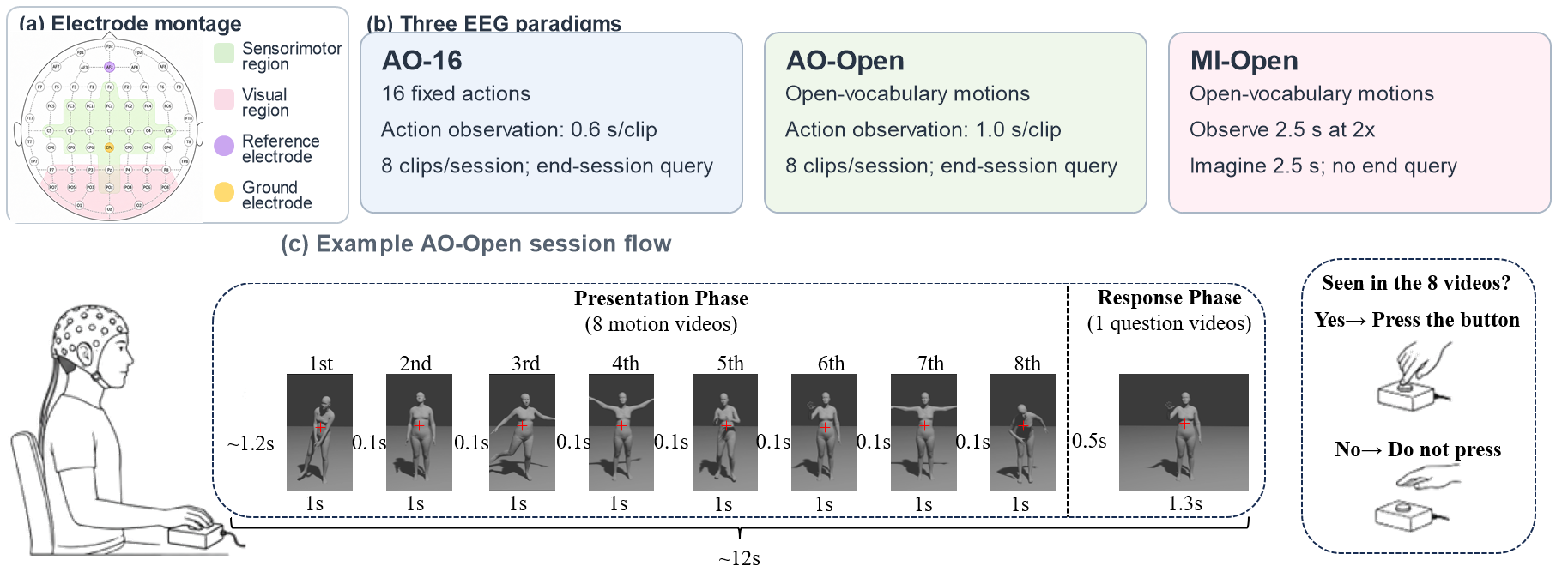
EEG2MOTION includes three data-collection paradigms. In AO-16, 7 participants observed 16 distinct actions, with each 3-second source motion played at 5× speed to produce a 0.6-second sample. In AO-Open, 9 participants observed motions from an open-vocabulary motion space, with each sample lasting 1 second. In MI-Open, 7 participants watched a 2.5-second motion and then imagined performing it for 2.5 seconds after the visual stimulus disappeared. The three datasets contain 20,000, 28,000, and 5,250 samples, respectively.
We visualize 3D full-body motions synthesized by EMMM alongside the Ground Truth. Each block contains the Ground Truth movement (left) and the motion sequence generated by EMMM (right).